Norfolk Drug and Alcohol Partnership
In June 2022 the Government launched its drug strategy From Harm to Hope: a 10 year drugs plan to cut crime and save lives. This strategy was developed on the back of a two-part review undertaken by Dame Carol Black.
As part of this strategy every area in England has been tasked with setting up a partnership that will be responsible for delivering the outcomes of the strategy in a way that is best suited to its population.
In Norfolk this is called NDAP, the Norfolk Drug and Alcohol Partnership. It is made up of a wide range of organisations and services which have come together to improve outcomes for people with substance use problems.
The national strategy has three priority areas:
- Break drug supply chains
- Deliver a world-class treatment and recovery system
- Reduce the demand for recreational drugs
In Norfolk, we also recognise the impact that alcohol use can have on local people, which is why our local partnership covers both drugs and alcohol.
Substance use has profound and wide-ranging impacts on individuals’ wellbeing, including their quality and length of life. It also affects family and community dynamics, places pressure on health and justice systems, and has wider economic consequences. Even recreational substance use, including levels considered low risk to individual health, can have broader societal impacts, contributing to crime, violence and exploitation.
Applying findings from national surveys (2021/22) to Norfolk suggests that approximately 44,000 people aged 16–59 have taken a drug, with around 13,000 using Class A substances such as heroin, methadone, cocaine or ecstasy. Cannabis remains by far the most commonly used drug. Nationally, there has been a decline in Class A drug use in recent years, and drug use continues to be more prevalent among younger age groups.
Alcohol consumption also represents a significant public health issue. An estimated 190,000 adults in Norfolk consume more than the recommended weekly limits. However, national data indicates a continuing trend towards lower alcohol consumption among younger people.
There are clear inequalities in substance use and its outcomes. In Norfolk, poorer health outcomes and higher levels of associated risk factors are concentrated in more deprived areas, which are predominantly urban. Substance use is often occurs alongside mental health conditions. Certain groups experience disproportionate harm, including some ethnic minority communities, people experiencing homelessness, sex workers, and individuals who have been in contact with the criminal justice system.
Children and young people are particularly vulnerable to the negative impacts of substance use. Use of substances is associated with increased risk-taking behaviours, and early initiation/experimentation can increase the likelihood of developing problematic use later in life. Risk factors such as parental substance use, school exclusion, childhood trauma and poor mental health can further increase vulnerability. Young people may also be at risk of exploitation, including through County Lines activity. Overall, levels of substance use among young people in Norfolk are lower than the national average.
Specialist treatment services play a key role in improving health and social outcomes. In Norfolk, around 4,400 adults are currently engaged in structured drug treatment. This is estimated to represent around half of adults with a treatment need related to opiate and/or crack cocaine use, and around one in five of those with an alcohol treatment need.
In recent years the proportion of Norfolk residents in treatment for opiate use has remained stable, while the number accessing support for non-opiate drug use and alcohol use has increased. Compared to the England average, a higher proportion of those in treatment in Norfolk report problematic alcohol use.
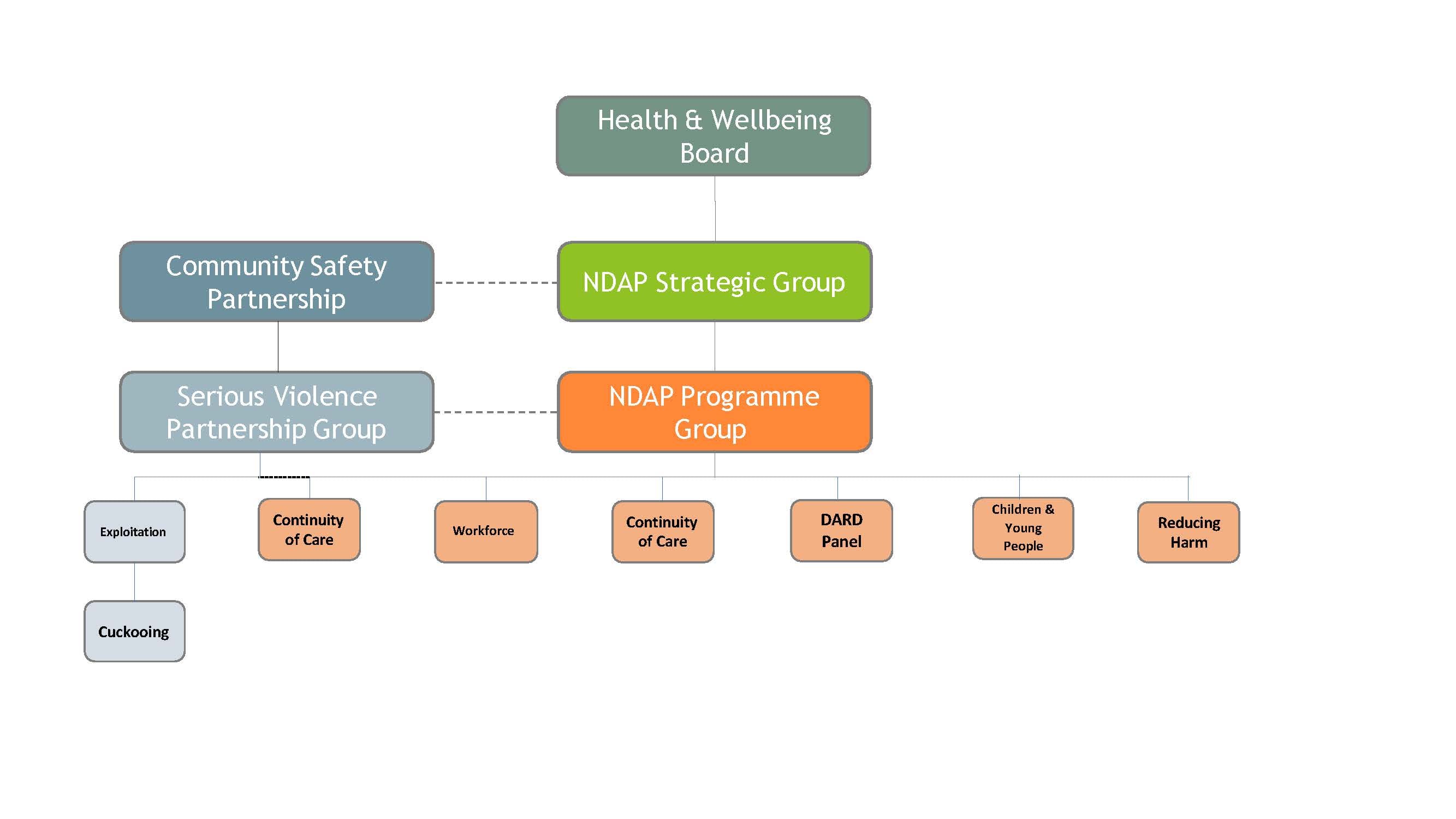
Norfolk drug and alcohol partnership governance structure as of January 2026
List of NDAP stakeholders:
- Norfolk County Council, including Public Health
- Norfolk Fire and Rescue Service
- Norfolk Constabulary
- Office of the Police and Crime Commissioner
- Norfolk Community Safety Partnership
- District and Borough Councils
- National Probation Service
- HM Prison Service
- Department of Work and Pensions
- Voluntary Norfolk
- NHS England
- Norfolk and Waveney Integrated Care Board
- Change, Grow, Live
- The Matthew Project
- Norfolk and Suffolk Foundation Trust
NDAP’s priorities for 2026–27 focus on improving safety, wellbeing, and outcomes across Norfolk. These priorities span our three core pillars and reflect the challenges and opportunities facing our communities.
1. Embedding the voice of lived experience
We are committed to ensuring that people with lived experience are represented at every level of our partnership.
Our work includes ongoing focus groups, recovery community support, and plans to expand involvement through events and wider engagement.
2. Improving outcomes for people with complex needs
We are strengthening our multiagency approach to better understand and respond to the needs of people facing multiple disadvantages.
This includes targeted work on the barriers experienced by women, particularly around late engagement and menopause related challenges.
3. Responding to emerging drug trends
Drug use trends continue to evolve, and we are enhancing our response to risks such as ketamine and synthetic opioids.
Partnership training, new campaigns, and improved clinical pathways are already underway, alongside planning for synthetic drug response and cocaine-related harm reduction.
4. Tackling exploitation linked to drug use
Working jointly with Serious Violence Duty partners, we are improving our county-wide response to exploitation, including County Lines and cuckooing.
This includes developing a multi-agency toolkit, mapping best practice, and using shared data to target interventions.
5. Strengthening co-occurring conditions pathways
We are progressing an integrated approach to supporting people experiencing both substance use and mental health needs.
This includes a developing strategy, joint commitments across partners, expanded training and coproduction, and improved transitions for people leaving secure settings.
6. Improving continuity of care from prison to community
More people are now receiving consistent support when transitioning from prison back into the community.
Enhanced in-reach, new release packs, rising continuity-of-care rates, and stronger links with referring prisons are driving this improvement.
7. Supporting workforce development
To maintain a skilled, confident workforce, we continue to offer extensive training across the system.
Plans for the year ahead include a refreshed workforce needs assessment, co-produced stigma training, enhanced multiagency learning, and a standardised impact framework.
8. Refresh and publish the Joint Needs Assessment (JNA)
We will develop and publish a refreshed, comprehensive JNA to better understand need, shape future strategy, and inform commissioning.
The JNA will be developed with input from the partnership and lived experience to provide a full comprehensive assessment and a summary overview document.
Change Grow Live (CGL) - Support for you
If you’re over 18 and worried about your own drug or alcohol use, we can help you break free from harmful patterns of behaviour, and feel happier and healthier. We tailor the drug and alcohol support we offer to fit your needs. Whether it's one-to-one working or group sessions, we will help you work towards your goals. We want you to unlock your full potential.
Our services include clinical treatment which may include blood tests and working together with the UROKET clinic.
We have needle exchanges where you can find harm reduction advice as well as blood-borne virus testing, naloxone training and access to other services.
We have hubs in Norwich, Thetford, King's Lynn and Great Yarmouth. We also see people in the community, so we can support you wherever you live in Norfolk.
> Change Grow Live Norfolk | Drug and alcohol support
Unity - Support for You
If you’re under 19 and worried about your own drug or alcohol use, Unity is here to help. The team offers confidential, non-judgemental support to help you understand how substances may be affecting you and to make positive changes if you want. You can get one-to-one advice and harm reduction tips.
The Unity service understand that everyone is different, and they will always try to meet each person’s specific needs - for example, if you feel anxious about meeting them, they can meet you somewhere you feel comfortable, or if you learn best in a certain way, they can support you to understand information in a way that works for you.
Alcohol, drugs and mental health support: